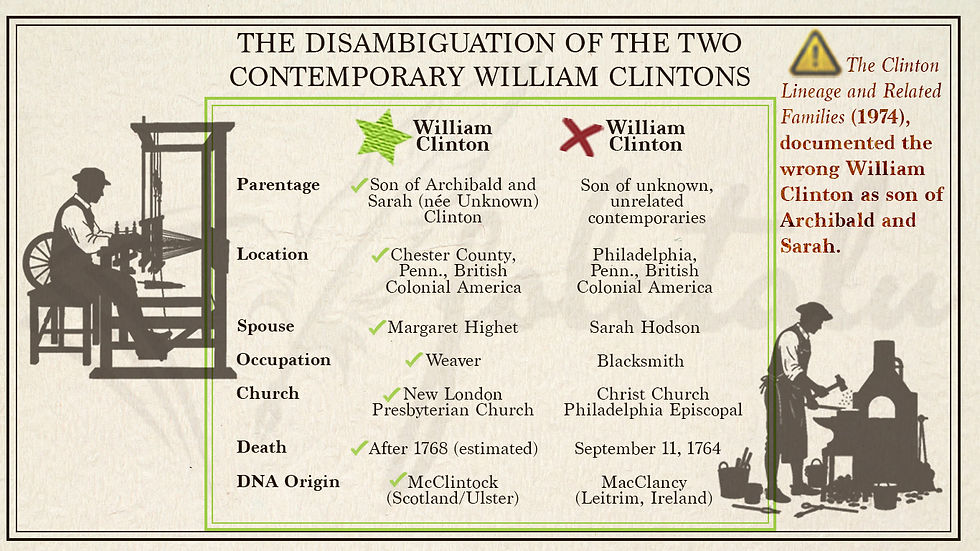
Our Forgotten Grandmothers: Daybreak on the Little River

Updated: Jul 8
For over a century, Captain James Clinton was our Clinton family’s sole gateway to the American Revolution. Letters from 1915 show our cousins writing to Washington to tease clues from his pension files, back when genealogy was an uphill battle fought through the mail.
But we inherit just as much DNA from the women who married into our lines as the surnames we carry. Our family histories like The Shelby Seekers and Our Family offered scant details on Sarah Shelby, wife of Captain James’ oldest son, John. Her parents were simply listed as William Shelby and a mysterious "Sarah" with no maiden name.
Thanks to modern digitized archives and new research tools, that wall has finally come down. We can now give Sarah’s mother her name back, and in doing so, we've uncovered a gripping, tragic story. Her family’s homestead sat on the edge of the early American frontier, and their fate on July 1, 1776, would become the tragic ignitor for the Cherokee Wars, a massive conflict that erupted in the backcountry at the exact same moment the Founders were signing the Declaration of Independence in Philadelphia.

This is the story of the Smith Family Massacre, and how our forgotten grandmothers were caught in this backcountry war. As we finally bring their names out of the shadows, we remember the ultimate price they paid, losing their lives on a frontier that was as brutal as it was beautiful.

The Family
The wilderness of the South Carolina backcountry required a relentless kind of grit, and by the summer of 1776, Captain Aaron Smith, company commander in the Ninety-Six District Militia, and his wife, Elizabeth Carraway, had carved out a thriving world on the banks of the Little River near the confluence with Hogskin Creek. While we don't know exactly when they first arrived on this exposed edge of Cherokee country, the evidence of their years of hard labor was everywhere. They had built a homestead from scratch that operated as a tavern with lodgings and continued raising a sprawling, tight-knit family of nine children.
"on the Eighteenth [October 1775] we came to Capt Aron Smiths: at this Tavern we found midling good Beds; but were obliged to Sleep in the woods the two proceeding nights; and on the Twentieth we arrived at Fort Prince George called old Keowes;" - Diary of English industrial spy and mineralogist Thomas Griffiths
On any given morning, the Smith homestead was a hive of activity. There were crops to tend, animals to feed, patrons to serve, and the endless daily chores of frontier survival. The clearing functioned as a bustling community of its own; living and working alongside the family were enslaved men who helped tend the land and keep the homestead running.
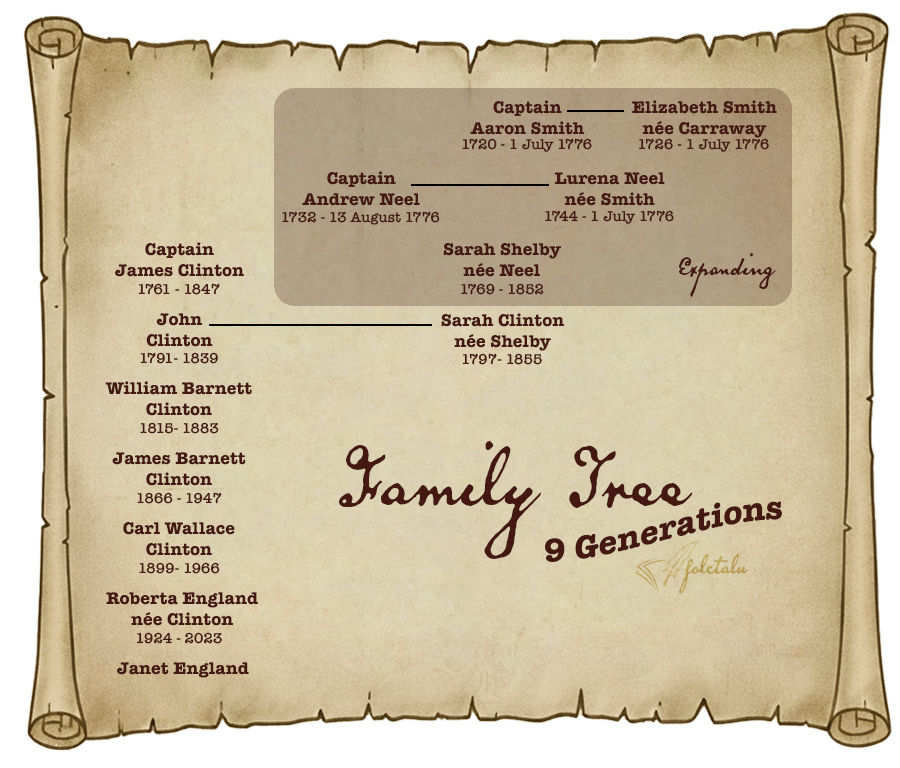
The family itself had grown and branched out. Three of the Smith sons were now grown men, and the nearby neighborhood was starting to fill with the sounds of a new generation. Their daughter Lurena, married to Captain Andrew Neel of the New Acquisition District Militia, lived close by with a busy household of five young children including our direct ancestor, little Sarah Neel.
Out here, family was everything, but the outside world was rapidly closing in on the Smith household. The gathering storm of the Revolution had already drawn the family into its wake; the older sons, Private Ezekiel and Second Lieutenant John Carraway, had already committed to the Continental cause and taken up arms. Their brothers, Thomas Keeling and Aaron Jr., had not yet signed up to fight, but the volatile backcountry was about to force the war directly to their doorstep.
The Attack

Encroached upon by white settlers stealing their hunting grounds, the Cherokee Nation received massive shipments of ammunition from British agent Alexander Cameron. While intended to secure tribal loyalty, these supplies ultimately gave the Cherokee the means to wage war. Seeking a diversion for their fleet arriving off Charlestown, the British urged the tribe to strike the western frontier. As soon as word arrived that the British ships had anchored, the Cherokee launched their assault on the backcountry.

At daybreak of July 1, 1776, a gathering storm broke over the Little River. Moving silently through the heavy summer brush, a party of Cherokee warriors shattered the backcountry morning with a sudden, terrifying war cry. Caught completely by surprise, Captain Aaron Smith and three sons that were at home, Thomas Keeling, Aaron Jr., and young Lorick, lunged into action, desperately defending their family in the ensuing chaos.
In the chaos, the exact order of casualties remains unknown, but Aaron Jr. later reported that young Lorick was struck down during the assault. When Captain Smith was also hit, Thomas Keeling fought back fiercely, killing the warrior who had felled his father. Realizing the homestead was entirely overrun, Thomas and Aaron Jr. made a desperate break for survival, and fled in different directions.
They were the only ones to make it out alive. Behind them, a scene of total devastation remained. Captain Aaron Smith, his wife Elizabeth, and five of their children, including their son Lorick and four unnamed siblings, were killed in the onslaught. Among those lost was likely their married daughter, Lurena Neel, who is strongly presumed to have perished alongside them. The violence made no distinction of status; five enslaved men were murdered in the attack as well.
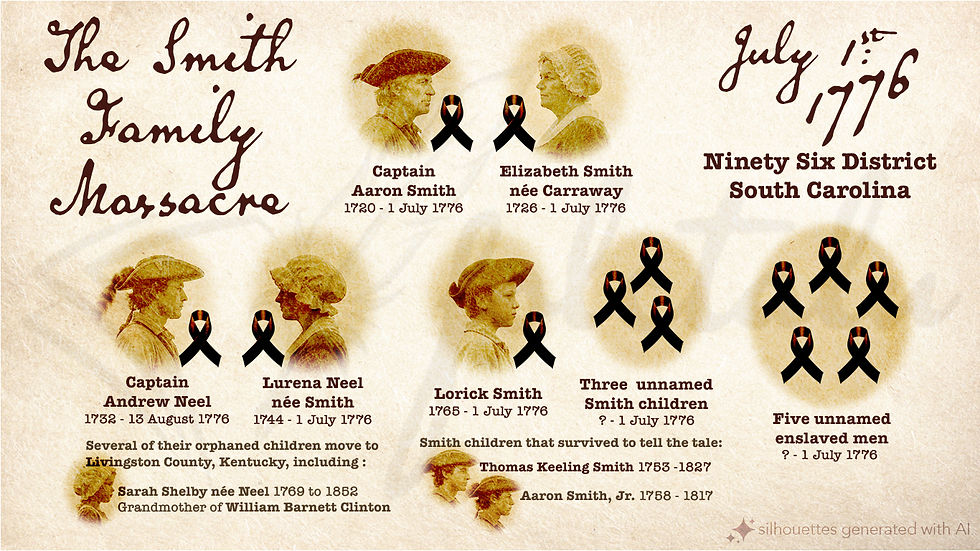
The true horror of that morning materialized later that day at the plantation of Francis Salvador on nearby Coronaca Creek. Out of the wilderness stumbled one of the surviving Smith sons, Thomas Keeling, exhausted and bloodied from a frantic, twenty-seven-mile trek. Gasping out the tragic fate of his parents, siblings, and the family's enslaved workers, he held aloft a mutilated hand where two of his fingers had been shot completely off.
Without wasting a moment, Salvador mounted his horse and launched into a grueling twenty-eight-mile gallop to Whitehall, the home of Major Andrew Williamson. He rode to sound the alarm, unaware that the news had already outrun him. Waiting at Williamson's residence was Aaron Jr., who had miraculously escaped the morning's slaughter. Aaron had just completed a twenty-six-mile trek to alert the major and rally the surrounding district.
Francis Salvador represented the Ninety Six District in South Carolina's provincial congresses (1775–1776). Killed on 1 August 1776, at the Battle of Esseneca at 29 years old, he was the first Jewish person elected to public office in the American colonies and the first to die fighting for American independence.
The Aftermath

In the first few days following the attack on the Smith family, Major Andrew Williamson found it incredibly difficult to rally men. Entire families were abandoning their homes to flee to safety and the east. He could only pull together 40 men at his plantation, Whitehall. By late July the rallying call was heard, and his force had swollen to roughly 1100 to 1200 men.
The violence of that July morning radiated outward like a shockwave. Driven by the horrors he had witnessed, Captain Andrew Neel immediately joined the retaliatory campaign against the Cherokee. He would not survive the summer. On August 12, 1776, just six weeks after the initial massacre, Neel was mortally wounded at the Ring Fight near the Cherokee town of Tamassee.
In the Name of God Amen. I Andrew Neale...I will that all my Lands be divided in equal proportion betwixt my Sons Thomas and Aaron, all my other Estate to be divided betwixt the said Thomas Neale, Aaron Neale, Elizabeth Neale, Sarah Neale and Ann Neale my Children equally, And lastly I do hereby appoint my Mother Sarah Neale Executrix and Thomas Neale Esqr. Executor of this my last Will and Testament, Sealed with my Seal and dated this thirteenth day of August One thousand Seven hundred and Seventy six.
As he lay dying the very next day, Andrew dictated a final will. In a heartbreaking detail that confirms the worst, his last words made no mention of his wife, Lurena. It is through this silent omission in a dying soldier's testament that we know Lurena had likely perished alongside her parents on July 1st or she had died earlier. In the span of a single summer, five young children, including our direct ancestor, little Sarah Neel, were left completely orphaned, their family shattered by the fires of the frontier.
But the tragedy did not stop at the edges of the Smith homestead; the shockwave of violence consumed the entire region. In response to the raids along the border, colonial militias launched a swift and merciless scorched-earth campaign against the Cherokee Nation. Over fifty Cherokee towns, along with their vital crops and winter food supplies, were systematically burned to the ground.
The resulting starvation, death, and displacement devastated the Cherokee people, ultimately forcing them to sign treaties that ceded millions of acres of their ancestral homelands. It is a deeply sorrowful chapter of history where the losses were total. Our family paid an unimaginable price in blood and orphaned children to hold a line, while the Cherokee Nation paid with their lives and their future to defend it.
Roots to Branches
Notes
"Lurena "is sometimes spelled, "Loewieny" or "Lourenna," in old records. Used "Lurena" for consistency.
While you will frequently see "Neal" used in modern generalized searches or digital indexes, "Neel" is the primary historical and genealogical spelling accepted by local historians, family lineages, and official revolutionary registries for this specific South Carolina family.
Multiple generations of descendants of Andrew and Lurena's children, used Aaron, Elizabeth, Andrew, Lurena, Smith and Neel in their given and middle names, remembering this family.
There are even more connections to this Neel family for a future story about Captain James Clinton.
Learn More
Harmon, Jonel Sharp, and Zinzilieta, Mary Dalby. The Shelby Seekers: The Allied Families of Cannon, Clinton, Dodds, Love, Posey, and Stembridge. Evansville, IN: Evansville Bindery, 1997. Privately published family history.
Whittington, Thelma Clinton. Our Family: Clinton, McKenny, Moxley, Neel, Towery, Towry, Crider. Evansville, IN: Evansville Bindery, 1999. Privately published family history.
Meriwether, Robert L. The Expansion of South Carolina, 1729-1765. Kingsport, TN: Southern Publishers, 1940. Map, "South Carolina Townships and Frontier Settlements."
Thomas Griffiths, “Journal of a Visit to the Cherokees,” typed copy (mimeographed, 1950), North Carolina Department of Archives and History; digital images, North Carolina Digital Collections, Records Concerning American Indians (https://digital.ncdcr.gov/Documents/Detail/journal-of-a-visit-to-the-cherokees-thomas-griffiths-typed-copy/6534535 : accessed 27 June 2026); citing original journal (1767–1768) in V&A Wedgwood Collection, Barlaston, England and his visit to the South Carolina backcountry.
John Drayton, Memoirs of the American Revolution, From Its Commencement to the Year 1776, Inclusive; as Relating to the State of South-Carolina, vol. 2 (Charleston: A. E. Miller, 1821), p. 339 to 342 (digital image 349 to 353 of 419); digital images, Internet Archive (https://archive.org/details/memoirsofamerica02dray : accessed 28 June 2026); transcribing original correspondence of Francis Salvador and Major Andrew Williamson regarding the Aaron Smith family massacre, 1–3 July 1776. You will read the original story in its original historical text and outdated language.
Bonnie K. Goodman, "OTD in History… August 1, 1776, Patriot Francis Salvador becomes the first Jewish death of the American Revolution," Medium, 11 September 2020 (https://bonniekgoodman.medium.com/otd-in-history-august-1-1776-patriot-francis-salvador-becomes-the-first-jewish-death-of-the-ef5ecc1c845a : accessed 28 June 2026). Summarizes the events surrounding the Smith Family Massacre and aftermath from Francis Salvador's writings.
Maryland Gazette, 12 September 1776, p. 2. col 2; digital images, Newspapers.com (https://www.newspapers.com/article/maryland-gazette-dispatch-from-major-wil/200491152/ : accessed 27 June 2026), citing Major Andrew Williamson, military dispatch concerning frontier uprisings and Aaron Smith, Jr., statement to John Purves, JP, regarding the massacre of the Aaron Smith family, July 1, 1776.
The Pennsylvania Gazette (Philadelphia), 4 September 1776, p. 3, cols. 1–2; digital images, Library of Congress, Chronicling America: Historic American Newspapers (https://www.loc.gov/item/sn84026371 : accessed 28 June 2026); citing Major Andrew Williamson, military dispatch concerning frontier uprisings and Aaron Smith, Jr., statement to John Purves, JP, regarding the massacre of the Aaron Smith family, July 1, 1776.
"Revolutionary War Pension and Bounty Land Warrant Application Files," database and digital images, National Archives (https://catalog.archives.gov/id/54246378: accessed 28 June 2026), application file W. 9390, Peter Clinton, S.C. (Pensioner: Frances B. Clinton), National Archives Identifier (NAID) 54246378; citing Record Group 15, Records of the Department of Veterans Affairs, National Archives, Washington, D.C. Citing an original daily journal kept by a member of Captain Peter Clinton's company during the 1776 Indian Campaign included in the pension application including a reference to the death of Captain Andrew Neel.
"Fort Rutledge: The Battle of Esseneca Town," brochure, South Carolina National Heritage Corridor, n.d.; digital image, Clemson University Historic Properties (https://www.clemson.edu/about/history/properties/documents/2.pdf : accessed 28 June 2026).
American Battlefield Trust, "Ring Fight," American Battlefield Trust, last modified 2026, https://www.battlefields.org/learn/revolutionary-war/battles/ring-fight, accessed 28 June 2026; citing the ambush of Captain Andrew Pickens's 25-man scouting party on 12 August 1776 near Tamassee. Captain Andrew Neel is historically identified as one of the soldier killed during this engagement.