


Captain William Simms on the Homefront: Profound Contradictions

Updated: Jul 14
Tracing the Revolutionary roots of my grandmother, Sarah Lela (McKinney) England, often feels like navigating an endless labyrinth of unproven lines and brick walls, a struggle genealogists call "The McKinney Maze." The breakthrough of a known, proven Patriot line came not through the McKinneys, but through her third great-grandmother, Nancy Simms, on the maternal, Beard side of grandma's family tree.

In the spring of 1779, Nancy’s father, a veteran militia officer named William Simms, stood on the rolling hills of northeast Albemarle County, Virginia, where the air echoed with the sounds of revolution. Along the fertile ridges that fed the waters of Priddy’s Creek and Blue Run, William was rapidly expanding a frontier legacy. He had first established his family along the creek in 1761, building one of the region's very first watermills to support his booming household. By 1779, William consolidated his holdings by purchasing a massive adjoining tract from Josiah Bush, turning Simms’s Mill into a vital wartime community hub.
Guarding the Convention Army


Living right between two giants of the American Revolution with Thomas Jefferson’s Monticello just fifteen miles south and the Madison family’s Montpelier a short ride north in Orange County, Captain William Simms was an absolute contemporary to the center of the early American political universe. But William did far more than mill grain to feed his neighbors; he helped forge a new nation. As a Captain in the Virginia Militia, he participated in a high-stakes, demanding homefront operation: guarding the thousands of captured British and German "Hessian" soldiers secured at the local Albemarle Barracks.

These captives, who are collectively known as the "Convention Army," had been marched 700 miles south through the winter snows after surrendering at the critical Battles of Saratoga in New York. The Continental Congress moved them to the isolated Virginia Piedmont specifically to relieve the strain on New England’s food supplies and to prevent British rescue missions. Remarkably, this massive influx of prisoners included not just British regulars and German "Hessian" mercenaries, but also hundreds of women and children. Whole families of camp followers, wives of officers, and children had accompanied the regiments across the Atlantic and shared in their captivity. When they finally arrived in January 1779, they found the log barracks near Ivy Creek completely unfinished and open to the winter weather. For Captain Simms and his fellow guards, maintaining rigid order required balancing strict security with human compassion, overseeing a makeshift "prison city" where captors and captive families alike scrambled to build shelters, clear land, and cultivate gardens just to survive.
The Convention Army comprised the British, Hessian, and Canadian troops under General John Burgoyne who surrendered at Saratoga on October 17, 1777. Though the 'Articles of Convention' treaty initially promised them safe passage back to Europe, the Continental Congress voted to suspend their embarkation on January 8, 1778. Instead, these thousands of prisoners of war were marched to Virginia, where they were held at the Albemarle Barracks (five miles northwest of Charlottesville) from January 1779 until late 1780.
However, Captain Simms's military duty extended far beyond the confines of the barracks walls. According to the detailed pension testimony of John Dalton, his son-in-law as of 1780 and a sergeant who served under him throughout the war, Simms later led his company into active operational zones across Virginia. When the British landed at Norfolk, Simms marched his men to Richmond and Cabin Point to intercept the threat. By June 1781, as the war reached its fever pitch, Captain Simms’s company was attached as a light infantry detachment under Colonel Duvall, serving as the critical rear guard for General Lafayette’s army. Positioned directly between the American and British forces, Simms led his Albemarle men through intense maneuvers across the Virginia countryside, clashing with Banastre Tarleton's troops at Wash’s Long Lane and engaging British scouting parties near Jamestown just prior to the siege at Yorktown.
Eight Daughters and Three Sons
Yet, while Captain Simms was maintaining rigid military order, he faced an entirely different kind of command at home. His personal life was its own complex web of frontier connections. After the passing of his first wife, Annister Stapp, William married Agatha who ongoing research suggests was likely Annister’s niece and also a Stapp. Between these two closely intertwined marriages, the rooms of the Simms homestead became a vibrant hive of family life that would ultimately produce eleven children, eight daughters and three sons.
In the spring of 1779, this meant his home was a bustling mix of family: two grown daughters and a son from his first marriage to Annister, alongside seven energetic children and teenagers, all eighteen and under, still under Agatha's watchful eye. One final son was yet to be born. Managing the rigid logistics of a wartime militia company was surely no match for guiding a frontier family of this size, whose brave spirit would soon carry the Simms name far beyond the waters of Priddy's Creek.
A Post-War Spiritual Shift
When the war ended, the rooms of the family home became the epicenter of a different kind of revolution, a spiritual one. While Captain Simms had served as a formal churchwarden for the state-mandated Anglican parish, the cultural and spiritual tide was shifting rapidly around his household. The family eagerly embraced the fiercely independent Baptist faith, and in 1781, the historic Priddy’s Creek Baptist Church was founded right in their backyard on the land provided by the prominent Brockman family. Deeply embedded in this movement, their daughter Nancy Simms carried our direct torch forward when she married Reverend Ambrose Brockman. By uniting with one of the region's most respected frontier families, Nancy joined a massive westward migration, carrying their pioneer faith into Green County, Kentucky around 1806.
Fascinatingly, this marks the fourth story I have written for America's 250th anniversary, revealing an incredible thread: three of these ancestral families were early pioneers of the Baptist faith. This shared conviction eventually intertwined deeply with the neighboring Creel and Stapp families, ultimately binding the ancestral branches of my grandmother, Sarah Lela (McKinney) England, and my grandfather, Henry Porter England’s, lines. If ongoing research proves that Agatha was indeed born a Stapp, it means she was a first cousin to Charles Creel’s wife, Sarah (Stapp) Creel, who also migrated to Green County, Kentucky.
Profound Contradiction
Captain William Simms passed away in 1797, leaving behind a complex legacy of industry, bravery, and deep family devotion. As we celebrate America’s 250th anniversary, we honor the millmaster of Priddy’s Creek for his wartime service, a sacrifice made while carrying the responsibilities of a large family. Yet, a full accounting of his life requires acknowledging that his vision of liberty coexisted with the institution of slavery. In remembering him today, we honor his patriotism while recognizing the profound contradictions of the world he helped build.
Roots to Branches with an SNL Connection
If you ever watch actor and comedian Bill Hader do a hilarious impression on Saturday Night Live or play other masterful characters such as, Barry, on HBO Max, you can officially tell everyone in the room: "Hey, that's our cousin!"
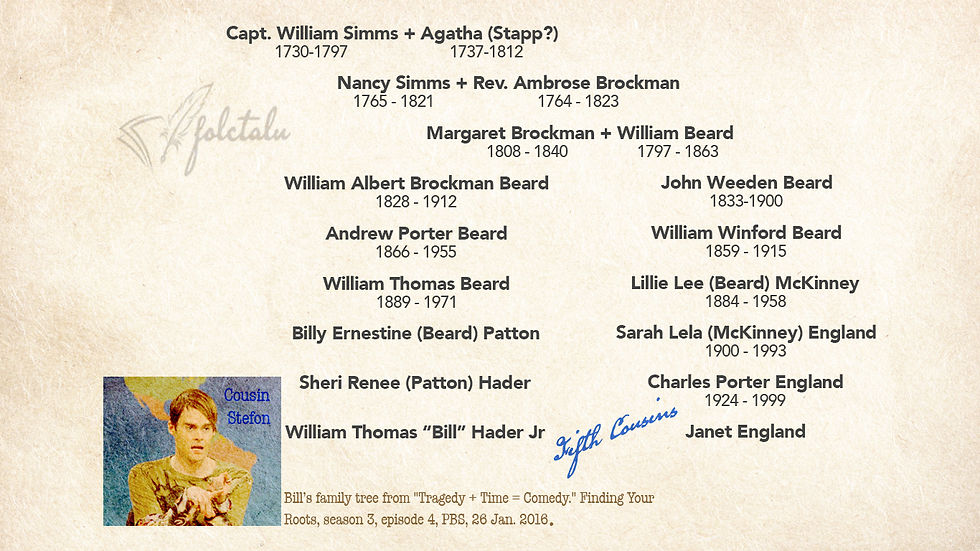
Thanks to a proven paper trail, we now know that Captain William Simms and his wife Agatha are the 4th great-grandparents of my grandmother, Sarah Lela (McKinney) England, and the 6th of Bill Hader. The most recent common ancestor is even closer with the family tree branching at the children of William Beard and Margaret Brockman, a Kentucky born granddaughter of Capt. Simms.
Notes
This family surname is frequently spelled Sims and Simms in records.
In 18th-century colonial Virginia records, Preddy Creek (located in northeastern Albemarle County) was routinely spelled Priddy Creek, often fluctuating based entirely on the clerk or landowner writing the document. Today, modern maps and regional landmarks (such as the Preddy Creek Trails Park) officially prefer the "Preddy" spelling, though the historical variant "Priddy" remains standard in early land patents and family genealogies.
Some records indicate William was in the 6th Virginia Regiment, but other records indicate he was a Captain of the Albemarle County Militia. Other records that I found only confirm the Albemarle County Militia.
When the TV series Finding Your Roots traced this lineage, the show highlighted the operational history of the 6th Virginia Regiment, tracking the siege of Charleston, South Carolina, the Battle of Monmouth, New Jersey, the Battle of Trenton, New Jersey and crossing the Delaware. However, broad-stroke television histories often follow a regiment’s paperwork rather than the boots-on-the-ground reality of detached service. Deep dives into local Revolutionary War pension files specifically the explicit testimony of John Dalton (NARA Identifier 54363806, File S.1755) reveal a very different, localized truth. Rather than marching north, Captain Simms’s company stayed on the home front to manage the massive security crisis right in their backyard before actively joining Lafayette's defense of Virginia. Relying on these firsthand accounts rewrites the narrative with historical accuracy, proving that Captain Simms's true impact was felt on Virginia soil.
Learn More
This history was compiled using genealogical resources digitized by the Internet Archive, including extensive Virginian genealogical collections published by William Everett Brockman between 1926 and 1959.
Brockman, William Everett. The Brockman Scrapbook: Bell, Bledsoe, Brockman, Burrus, Dickson, James, Pedan, Putman, Sims, Tatum, Woolfolk and Related Families. Minneapolis, MN: W.E. Brockman, 1952. Digitized by the Internet Archive. https://archive.org/details/brockmanscrapboo00broc.
Brockman, William Everett. Early American History: Hume and Allied Families. Minneapolis, MN: W.E. Brockman, 1926. Digitized by the Internet Archive. https://archive.org/details/earlyamericanhis01broc.
Brockman, William Everett. Orange County, Virginia, Families Volume III. Minneapolis, MN: W.E. Brockman, 1959. Digitized by the Internet Archive. https://archive.org/details/orangecountyvafa03broc.
Woods, Edgar. Albemarle County in Virginia: Giving Some Account of What It Was by Nature, of What It Was Made by Man, and of Some of the Men Who Made It. Charlottesville, VA: The Michie Company, 1901. Digitized by the Cornell University Library via the Internet Archive. https://archive.org/details/cu31924028785703/.
Meade, William. Old Churches, Ministers and Families of Virginia. Vol. 1. Philadelphia: J.B. Lippincott & Co., 1857. Digitized by the University of Toronto via the Internet Archive. https://archive.org/details/oldchurchesminis01meaduoft.
Reynolds, William W. "Demise of the Albemarle Barracks: A Report to the Quartermaster General." Journal of the American Revolution, May 31, 2018. https://allthingsliberty.com/2018/05/demise-of-the-albemarle-barracks-a-report-to-the-quartermaster-general/.
"Tragedy + Time = Comedy." Finding Your Roots with Henry Louis Gates, Jr. Season 3, episode 4. Directed by Sabin Streeter. Featuring Bill Hader, Jimmy Kimmel, and Norman Lear. Aired January 26, 2016, on PBS. https://www.pbs.org/video/finding-your-roots-tragedy-time-comedy/. They made some broad stroke statements about the Virginia 6th regiment that don't match the account given in pension statements, especially, John Dalton, William's son-in-law.
"Orange, Virginia, British Colonial America records," images, FamilySearch (https://familysearch.org/ark:/61903/3:1:3QS7-L9PX-X4BY?lang=en : Jul 13, 2026), image 198 of 281; . Image Group Number: 007645702. Will of Samuel Brockman witnessed by James Madison, Sr and William Sims.
"Albemarle, Virginia, United States records," images, FamilySearch (https://familysearch.org/ark:/61903/3:1:3Q9M-CS4N-D34Z-H?lang=en : Jul 13, 2026), image 257 of 287; . Image Group Number: 007893702. Annister (Simms) Brockman and her husband Samuel Brockman purchase Capt. William Simm's land after his death with names of children and spouses are listed.
"Albemarle, Virginia, United States records," images, FamilySearch (https://familysearch.org/ark:/61903/3:1:3Q9M-CSLZ-P9JW-1?lang=en : Jul 13, 2026), image 231 of 279; . Image Group Number: 008189593. Estate case that lists all the Simms children and spouses and protecting the rights of minor child Richard Simms and an adult child, John, with some type of cognitive disability or mental incapacity that he needed to be represented by a committee.
"Albemarle, Virginia, United States records," images, FamilySearch (https://familysearch.org/ark:/61903/3:1:3QS7-89P7-978S?lang=en : Jul 13, 2026), image 176 of 190; . Image Group Number: 007643846. Household inventory of William Simms including nine enslaved people with names, Bob, Patty, Billy, Lucy, Joe, Cate, Moses, Stephen, and James.
Case Files of Revolutionary War Pension and Bounty-Land Warrant Applications, 1800–1900. Record Group 15: Records of the Department of Veterans Affairs. National Archives Building, Washington, D.C. Digital images, National Archives Catalog, National Archives Identifier 54363806. https://catalog.archives.gov/id/54363806. John Dalton indicated that he served at the Albemarle Barracks and Virginia specific operations with Capt. William Simms, his father-in-law.
