


Flint and Dark Ink: The Revolutionary Legacy of Charles Creel

Updated: Jul 15
Growing up, you would never have guessed that my grandpa, Henry Porter England (1893–1968), carried the blood of some of the wealthiest pioneers in Green County, Kentucky. His world was one of humble beginnings and hard, uncelebrated work in a life far removed from the halls of wealth. Yet, if you follow his family tree back through the generations, it leads straight to a pioneering dynasty and one of the grandest houses in early Greensburg. At the root of that forgotten fortune stood a soldier of the American Revolution named Charles Creel, Grandpa's 3rd great-grandfather.

Fracture along Religious and Political Lines
Before the war for independence, Charles spent his younger years in Orange County, Virginia, a frontier transforming into a wealthy tobacco and agricultural society. Montpelier, the lifelong home of a contemporary, James Madison, fourth President of the United States, was in Orange County. One of the most significant civilian movements in the county in 1776 centered around religious liberty. At the time, the Anglican Church was the government-established church, and settlers of other faiths such as Baptists, Presbyterians, and Methodists, known as "dissenters," were taxed to support it. This environment deeply influenced James Madison's later obsession with protecting religious liberty.
"Liberty or Death" and “Don’t Tread on Me”
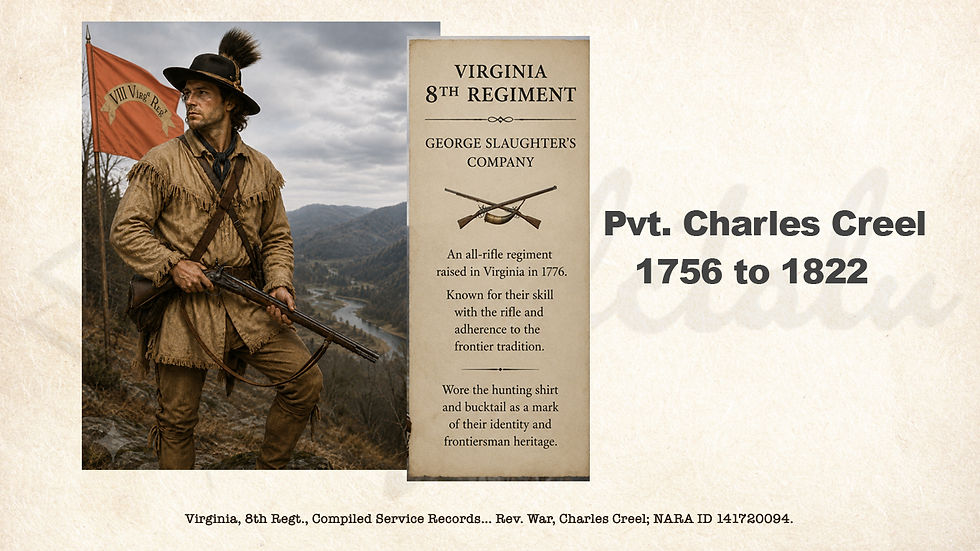
In February 1776, Charles enlisted as a private in Captain George Slaughter’s Company of the 8th Virginia Regiment, dubbed the "German Regiment.” This regiment was forged from the rugged frontiers of the Shenandoah Valley and the state's northwestern counties and drew a fierce, multi-ethnic mix of German American farmers and Scots-Irish woodsmen. While most eastern regiments carried muskets, this unique frontier unit carried deadly accurate hunting rifles.
Captain Slaughter’s company was recruited out of Culpeper and nearby Orange County. This unit may have previously served as a company of the Culpeper Minutemen, who famously carried a localized variation of the iconic yellow Gadsden flag. In addition to the original coiled rattlesnake and "Don't Tread on Me" motto, their standard featured the famous rallying cry of their commander, Patrick Henry: "Liberty or Death."
By the summer of 1776, they were officially absorbed into Washington’s Continental Army, enduring a grueling march to defend Charleston at Sullivan's Island against a British naval assault. The company was then recalled north to join General George Washington's main army for the Philadelphia Campaign of 1777, where they stood their ground during the intense, chaotic fighting at the Battle of Brandywine. The arduous journey of this tight-knit company culminated in the bitter, freezing hardships of the winter encampment at Valley Forge, marking a remarkably rugged and historic record of service across both theaters of the war.
1798 Migration to Green County, Kentucky
Charles left service after his two year enlistment and married Sarah "Sallie" Stapp in 1778. In 1798 Charles migrated to the burgeoning frontier of Green County, Kentucky with some of his older sons settling in the area that became Adair County in 1802. There, the family’s footprint expanded rapidly. In 1820, Charles and his wife, Sallie, helped found the church that became Greensburg Baptist. That same year, Charles’s son, Elijah, cemented the family's elite status by building a grand, Federal-style mansion that remains a historic local landmark. This frontier prominence eventually launched generations of notable descendants into international history, including diplomatic ambassadors and governors.
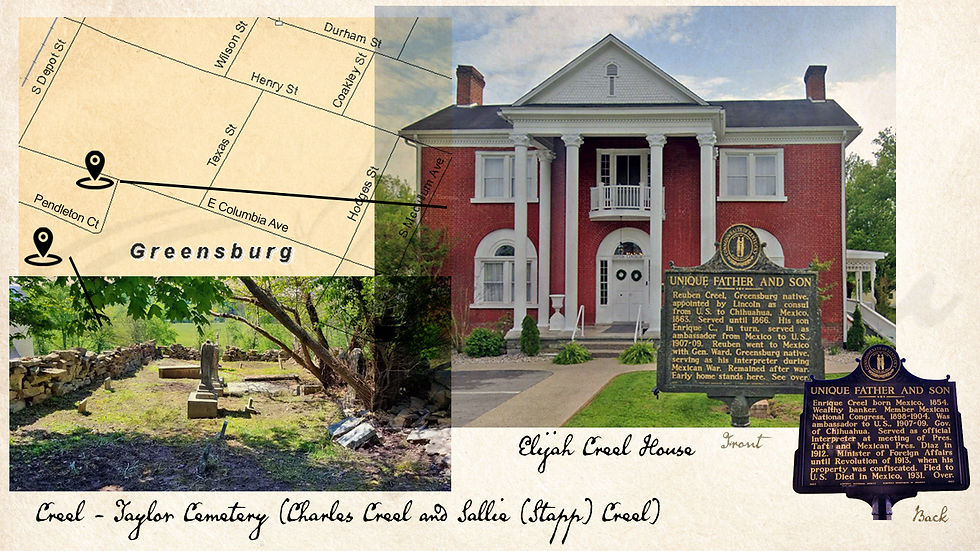
Yet, within this grand dynasty lay deeply personal tragedies. In 1821, just a year after that landmark mansion was completed, Charles’s grandson and our direct ancestor, Benjamin Silas Creel, was orphaned at just six years old. His father, Silas Creel, had passed away in 1817, and his mother, Elizabeth (Cook) Creel, followed in 1821. Though left alone at a tender age, he was far from destitute, having inherited substantial wealth from his parents and his grandfather Charles. One cannot help but wonder if the young boy grew up within the walls of his Uncle Elijah's grand estate, shielded by a frontier fortune but marked by early loss.
While historical accounts often focus on the family's prominence, the true ledger of their wealth is written in a far darker ink. Through the examination of their wills, it is clear that Charles and his family were enslavers. These legal documents, which once proudly itemized the family’s immense economic prominence, serve today as a stark reminder of the human cost that fueled the forgotten fortune from which my grandfather descended. In his will, Charles Creel instructed his executors that the sale of any enslaved people must be a private auction held strictly among his own children.
Roots to Branches

Learn More
"Virginia: Eighth Regiment, Creel, Charles," Compiled Service Records of Soldiers Who Served in the American Army During the Revolutionary War, compiled 1894–1912, documenting 1775–1784; War Department Collection of Revolutionary War Records, Record Group 93; National Archives Catalog, National Archives ID 141720094 (https://catalog.archives.gov/id/141720094: accessed 23 June 2026).
"Muster Roll of Capt. George Slaughter’s Company, 8th Virginia Regiment, May 1777," Compiled Service Records of Soldiers Who Served in the American Army During the Revolutionary War, 1775–1784; War Department Collection of Revolutionary War Records, Record Group 93; National Archives Catalog, National Archives ID 503411226, image 2 (https://catalog.archives.gov/id/503411226: accessed 23 June 2026).
“Our History,” Gupton-Landrum Funeral Home (https://www.gupton-landrum.com/about-us/about-us: accessed 25 June 2026), historical sketch of the Elijah Creel house (Greensburg, Kentucky), detailing Reuben Creel (U.S. Consul to Mexico) and Enrique Creel (Governor of Chihuahua and Ambassador to the U.S.).


